archives & links below

My photo
A person who needs no introduction.
Showing posts with label music. Show all posts

Monday, March 20, 2023

13'11"

 The piece of music that did more than any other to make me a Classical Head instead of a Rock Head (though I play both as well as I can) was Rhapsody in Blue, and the performance that put it in my heart was Gershwin's own expressive piano roll.


Fifty, fifty-one years ago, I came across a set of LPs that Dad had of reproducing roll performances by Gershwin, Ravel, Prokofieff, and other legends of the keyboard. Gershwin's roll represented the composer's choices for tempo and other things, as well as his phenomenal skill.

Somewhat impressively, he sat down and overdubbed part of the roll, covering the thickest parts of the score, matching the tempos and keeping the live feeling. As a bonus, it has sections that aren't included in the solo piano score published by Warners. I was to learn why later.


I can tell you now, though. Everybody loved this piece, but they also felt like it could be cut at will without losing anything. Leonard Bernstein, in a tribute that feels patronizing, says it's just wonderful how we can cut this and that from it, and it's still enough, right?

And cut they do, possibly because Gershwin was eager enough to get the piece recorded that he agreed to set it down on a single disk, even if that meant cutting between a third and a half out and joining the bits with fillers that I hope came from the composer, at least.

For reasons of time (Whiteman had announced a concert piece premiere that Gershwin hadn't agreed to), Whiteman had the composer provide a two-piano (partial) sketch that Ferde Grofe would then orchestrate for the concert. This worked out, and Whiteman decided that, therefore...

...he, Paul Whiteman, was henceforward entitled to have his guy touch up and abridge every concert work Gershwin wrote, but that's another story, and he seems to have cut it out after a while, but not until making an 'alternate' Concerto in F at two thirds the length.

Anyway, I started 'working' on the piece while still in high school, and have subjected any number of ears to the work in progress over the years. As my technique has improved, I am finally where I can believe I'll be able to overcome all the wrong stuff I taught myself...

...and be able to simply sit down and play the whole thing when I want to hear it. Last night, I traversed the score of the familiar blue-cover version published by Warner, reaching the end without disaster. And PARTS OF IT WERE GOOD. I plan to improve what I can do. Here's hope.

Friday, February 03, 2023

More Technique: Piano Stuff.

Photo by Baron Dave, 2005. I had hands then, too! Taken at Minicon.

So much of the time I spend learning a piece now appears, in the cold light of decades of days, to be time spent figuring out how it should sound. Even as I built a pretty good facility for sightreading whatever didn't scare me off at second glance, I still had to deal with the ingrained presence of Mister Fuckup.

Mister Fuckup lives in my head, with some other entities we don't need to discuss now, and his sole joy in life is making me play the next wrong note. (He moonlights as a typing coach, by the way.) Even as I improved my playing and gained some welcome certainty over the easier notes, Mister F still reigned unchecked. My own personal Muse of Failure, living on the road between Intention and Execution, his specialty was finding the moment of confidence after playing three things right in a row and starting to believe I'd make it to the end unscathed. Implacable, non-negotiable.

The first partial victory against Fuckup was when I noticed one day that I was talking to my hands, as if they were individuals with wills of their own. And maybe they are. Anyway, I was embarking on a tough passage, and I beamed a thought like "And if Righty fluffs the melody up there, Lefty, you're doubling it anyway, so lean on it and we'll get through this," and then I caught myself doing it and realized that as long as I was making up entities, I should concoct an invisible henchman whose only job is to keep my place in the score (I had just done the crushing job of deducing that losing my place was a drawback. Offstage.) and threaten it with dire things if it didn't keep a running spot tally for my eyes to return to. 

And what do you know? It worked. My playing improved more quickly than usual for a while. I'd injured Mister F.

In many ways, it's good to have a brain you can take out and play with sometimes. With a number of little hacks and kludges, I began to get fairly reliable within my level. I even began to notice some things about my playing that went back to the very fundamentals of playing.

Remembering about Dad's advice, via Martha, to know what the passage is supposed to sound like before trying to play it makes me think of the long times I would spend trying to make a piece of music match what I heard in my head when that aural image was overly vague or otherwise just plain wrong to start with. 

I not only increased how much I'd work on each hand by itself (oh yeah, we're talking piano here), but made it a point when needed to dissect one hand's part for a measure, even playing it with both hands until I had the sequence of notes and rests down in my head. Has this made a difference? No, I've cunningly spent all these paragraphs saying it didn't, ell oh ell, aitch aitch oh kay, ess aay ess. Of course it made a difference!

It turns out that subjecting myself to continuous cognitive dissonance by looking at the right notes while thinking the wrong ones can wear you out, and stopping it is a relief, even if you don't replace it with anything. If you replace it with something, though, may I recommend mentally shouting out the name of the note when you see it in notation instead of trying to cultivate the Blind Zen Archer bit. It turns out that successful blind Zen archers were remarkable because most of them failed and found something better to shoot for and are now faintly embarrassed by the whole archery phase, to be honest, and they have a ukulele right here.

Getting back to me, however, I'm passing along my advice to myself: Figure out the real melody as soon as possible. It's never too late, luckily, to start working toward it and away from the broken version of a tune I'd substituted. When temptation strikes to keep the wrong one, I can refer to a mental image of something my best piano teacher, Mr. Diebel, said about a very similar topic. 

"Write your own damn music."

.

Tuesday, July 19, 2022

A Timely Tip

Playing piano at Minicon about 15 years ago. Photo by Tony von Krag.

When you're learning to play a piece--on the piano, in this case--it's helpful to learn the melody by humming or whistling or la-la-la-ing. This piece of advice from my father, a piano teacher, has turned out to be very useful recently. Makes me wish Dad had told me years earlier. Or at all.

As it happens, I got this pointer from my sister, to whom Dad told it decades ago. Dad tried twice to teach me and we apparently came up with a mutual unspoken deal where I'd struggle by myself for years and he'd occasionally offer me a suggestion that would usually prove useful, though not as useful as learning to finger, or acquiring basic harmony knowledge. After I finally started spending my own money for lessons, Mr. Diebel (I expect his proper title was Dr., but I never heard it used or requested) patiently addressed the worst of my deficiencies, ignoring my utter helplessness from his friendship with Dad. Dad once asked him what the main thing was he'd taught me, and Diebel answered by putting five fingers on his arm and saying "One, two, three, four, five." When I came to him, I acquired most notes by moving my hand. When we moved out of state a year or so later, I was about where a second or third-year student might be, provided nobody asked any theory questions, including "what key is this in?"

Fortune and decision brought me to theory. First, I noticed the existence of the Irish jam on Cathy's campus and started going. I tried playing my tiny backpack keyboard, but it was nigh inaudible in the room full of fiddlers and accordionists. I brought my accordion in (never learned the bass notes) and sight-read on that for a while before buying a five-octave keyboard with full-sized keys I could play. That led to a feeling of obligation toward those chord names over the tune sheets we used, and I started filling in, first with just the roots of the chords, then block chords, and finally comping. That's when a light bulb in my head said "You should take theory now, before you graduate." So I took four semesters off my art major and just took the sequence, not even for credit. I had some questions early on which my teacher answered by having me sit in on the aural training class concurrent with the theory cycle. 

I figured I knew enough theory from osmosis that I could start the class without a semester of "this is your finger and this is a note," and I was almost wrong but got through it with a simple trick I've mastered of clenching my entire head and keeping it that way until a problem seems to solve itself. The theory homework had the side effect of teaching me legible musical writing, which worked out because I also started writing some pieces of music in the same format we used in the jam. The class and sessions are the best musical education I've received, and I wish I'd done it decades earlier. 

I was talking to a couple of friends in the group (dang! I have friends here.) about playing outside the sessions to do other kinds of music. Suddenly, people started getting Covid and parts of society shut down, including all campus activities like ours (mostly peopled by non-college folks). My friend and I exchanged mp3s for a while, then started meeting under extremely careful conditions. After two years and change, we pick up new pieces pretty quickly (the tough ones take longer), often making our own non-virtuoso arrangements for the purpose. That's when Martha mentioned the bit about humming.

Who knows if I could have taken music theory earlier? I had one theoretical sort of class in Georgia but was trying to do math and computers and art. Would I have shrugged it off like my first (and second) lessons? Would Dad's pointer have taken root if he'd told it to me himself? Who sawed Courtney's boat? 

I'm taking away from this exactly what I'm getting: a tip that makes it even easier at a time when it's continually getting easier. With any luck, I'll get up to Michigan in the Fall and have a chance to show Dad how my playing is going, and mention that I'm using his tip. There's some baggage lying around that I don't feel like picking up. It'd just slow me down anyway, and nothing in it's of any real value. 

Left foot. Right foot. Am I there yet? 

Repeat.

.

Monday, July 04, 2022

From The Record Canister

We used to have a canister which might have originally held potato chips, but which was about 8" across, making it suitable for a stack of 45s and kiddie 78s. At a point in my life at which I had less control, I turned left and they turned right, and I never saw or heard them again, but my mind's ear provides replays of them, nestled in with the ringing.

One of the more peculiar of these kiddie disks was on the flip side of "Tattle-Tale Duck" ("Tattle-tale, tattle-tale, quackity-quack! / He tattles in front and he wiggles in back! / So watch your step, / You're out of luck / If you get caught by the tattle-tale duck!"), with the mild title "Ducks On Parade." 

It doesn't seem to be online. I checked, but you check as well. Sometimes I miss things.

Unlike most of the songs I'd hear in this enigmatic stack of clues to the greater world (such things would come my way, and I'd puzzle over their meaning as I labored to get the words right) this one had no lyrics. It was a pure instrumental, and if I'm any judge, it was made up on the spot. The instrumentation eludes my mental track, but the underall obbligato was a rhythmic quacking sound. Not a real quack, but a quacking sound. Not to put too fine a point on it, it was obviously a toy duck of the sort Lucy Van Pelt might have pulled around in a desultory fashion in a 50s Peanuts strip. And I'm not sticking my neck out very far by boldly asserting that someone had a wheeled duck toy and put it on one of the turntables in the studio and held it while the table turned, producing a quasi-quack-quack track.

And heck, that's really the interesting bit, right there. The melody is a series of tentative beginnings of phrases.

Doo.
Dooby dooby doo.
Dooby dooby doo; dooby dooby doo; dooby dooby doo.

(repeat a note higher; keep fumfering with it, and eventually back out more or less the same way)

It didn't have to be long. A 5" 78 record isn't good for much more than a minute, if that. So I guess either someone was screwing around with the ducky and the producer said "Let's record it," or else they were sitting around desperate for one more side that day, and the guy at the turntable said "How about this?" and put the duck on, and then the piano guy made up this tune, and eleven minutes later, they'd recorded it and mastered it and gone out for drugs.

You'll let me know if you find it, won't you? I haven't heard it in over fifty years. I mean, outside of  my head. Also, if you happen upon it, I'd really like a copy (even just audio) of the ~1970 ad for Clearasil or Noxzema that has the obnoxious "I am an Acne Pimple!" song that haunts my inner ear, where it threatens to overturn my balance.
.

Saturday, November 14, 2020

 About 1983, I recorded accompaniments to a couple Spanish hymns, and became fond of one of them. I hadn't copied it out of the hymnal when I returned it, and in the decades since, I've looked for it. I found it last year. "Yo solo espero ese dia." It's as nice as I remembered.

I found a YouTube of a congregation singing and playing it with accordions, guitars, and more intricate rhythms than the score suggests. It was an ear-opener, though I may still play it as before, with sweet intent.


The weird thing, though, is that while I was watching that, I suddenly clicked on the beat-for-beat similarity between this hymn and a French song "The River Seine," which I first heard happily murdered by Jonathan and Darlene Edwards (Jo Stafford and Paul Weston).

So sorry I can't give you Darlene ("video not available"--I got that close), but here's an instrumental version on a sweeeet 1950s-looking portable wind-up phonograph (similar to the one I first heard "Carmen Boogie" by The Crew-Cuts on):

Copyright? The version of the hymn I found has an earliest (c) of 1954 on it, but that's for an arrangement. No telling how old the anonymous melody there is. The song was first recorded in 1948, in French. I can't tell who swiped from who, but SOMEBODY SWIPED FROM SOMEBODY.

That's all. No resolution from me at this time, but if I ever find out, you can just bet I'll tell you about it.
 
originally a series of tweets. still is.
. 
.

Sunday, February 18, 2018

New Phases and Unrelated Matters

.
1 New Phase

I'm into a new phase. Where I had been reading at the gym during the hour I'm on the Futile Cycle and the Trudgemaster, I am now listening at the gym. The new storage card on my audio player is so darn big, I loaded hundreds of hours of radio shows (Gunsmoke, Marlowe, Johnny Dollar, Shep, ISIRTA, Hitchhiker, Lux, Lampoon, and anything by Welles seem to make up a lot of it). 

I've enjoyed my recent reading of screenplays, Doc Savage books, and whatever else I could find, but I haven't enjoyed the days when the scale showed me gaining weight back that I'd been keeping off since they sawed out my gallbladder, and I noticed after a couple of days of audio narrative that I seem to be able to keep the heart rate higher and cover more phony miles when I'm not taking info in through my eyeballs.


It took a couple of days to get used to not reading. It helps to not turn my tablet on at all, obviously, but then I start looking at the screens at the front of the gym. Closing my eyes works for that, at least often enough to break the spell. Even with that, I ended up comprehending the last half of some drama about agents (FBI, I guess) getting the last laugh on a mad bomber who killed six redshirts under our hero's command in the backstory. I almost looked at the guide to see what series it was when I got home, but then realized it just didn't matter and never would, so I did other things.
.

.
2 An Unrelated Matter

In an unrelated matter, I got some help with ignoring the voices in my head from a surprising source: the voices. Most of the time, they're no problem—they're entertaining, and a rich source of crazy ideas A, B12, and D3. When I'm playing or practicing piano, though, it gets to be a bit much. As I explained once, it's a little bit like practicing while Robin Williams stands just off to the side, quietly but audibly free associating the whole time. 

I've long been aware that something has been acting as a wall that I regularly would hit while trying to execute some piece of music. I'd be doing fine, then bammo! Mr. Fuckup strikes again! Well. One day I was playing along, and the second internal track was doing its usual distracting thing, and a voice on that track actually said something very much like, "You know, these voices are probably part of what's keeping you from playing better." BINGO.

Having a brain that thinks it can multitask isn't always a bad thing. A while back, I made a big improvement in my playing one day when I noticed that I was mentally sending a directive to one of my hands along the lines of: "Okay, if Right Hand doesn't peg the melody in the part, just outline it in the thumb line." In other words, I was designating imagined entities for specific tasks. So I created an invisible henchman (I should give him a name—he's earned it) and tasked him with always knowing where I should be looking in the score. Looey (there you go) stepped up to his job admirably, and my playing was noticeably better.

So I had this resource, and I needed to figure out how to make it work for me, given that even if I pay close attention to a measure and get it just right, my subsequent thoughts (Got that just right! Oh, if only X was listening right now! It would go a little… like… THIS:…) would take me right off the rails again. 

I ended up with something like the bit in my 1970s Transcendental Meditation™ training where the instructor (Jeff Peckham) said, "From time to time, your mind will want to wander. This is okay. Just gently put it back on the track and resume your meditation." (I dropped Jeff's name up there because I saw a news story a mere handful of years ago about how he was being a gentle thorn in the side of some local movers and shakers, and that made me proud to have briefly been his pupil.) What I decided to do was to put a question foremost in my mind that I would return to again and again, like the protagonist in MEMENTO reading his tattoos in the mirror. That question is "What do I have to be doing RIGHT NOW?" It became my new mantra for practicing. Heck, maybe I should use it for everything, along with my philsophy of life, "Left foot. Right foot. If not there yet, repeat." 

So I use it, and I think it helps that I've been playing with the Irish group now for about three years, and that I'm in my fourth semester of music theory and aural skills. The answer to that question is always a combination of words ("Next comes a chord with A at the bottom and a C# under your middle finger"), and the look of the notes, and the feel under my fingers of how the correct combination will be. It's a description that should include every note to be played (though if one hand knows its part well enough, I can expend most of the energy on the weak one). 

So far, so good. It's like I'd been around 65% of where I felt I should be, and have now gotten up to 80%–85%. When I'm playing something I know intimately, even if I haven't done justice to it in execution, the figure feels even higher.

Thanks, voice. That was useful! I haven't shut you out of my head, because you've been useful to me more than twice, and you're entertaining when I'm mowing the lawn or washing dishes. Also, I probably can't. You're still there when I'm sequentially depressing those keys, but you're not the boss of me, and you're way less distracting. So far, so good.
.

Saturday, March 28, 2015

a close reading


Overanalysis, based on the stuff I've written on my copy of the music. Unlike a lot of pieces, where I've written just a couple of things, like reminders of a sharp or flat, or a fingering, I really notated this one to the hilt, and now I'm expanding on that, you lucky, lucky person. (almost said 'people')

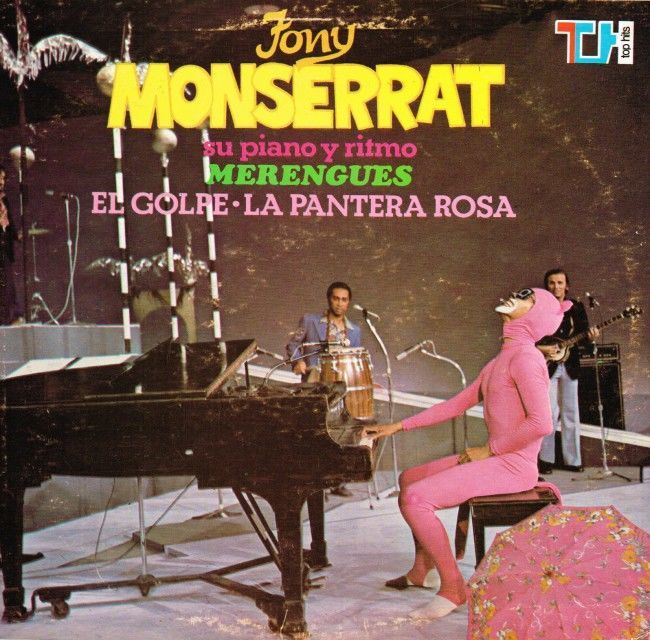
"The Pink Panther" (theme for the original movie) by Henry Mancini. Arranger's name not given. It'd be nice if it was really Henry's handwork, but if this is an anonymous staffer, I wish they'd allow them to take a bow for the nice job they did here.

Piano solo: the 4-page version, not the punky little two-pager. I searched for years for the longer version of this piece, with the bridge, and found it in one of those cheap, pulp-paper collections that used to go for about $10 and are now maybe $14. 

The piece starts with the cat offstage, and that one ambiguous non-chord drifting in like cigarette smoke from just around a corner, where all we can see is a French Galoise at the end of a long, black holder. 

The accompaniment comes in first, and it tells us a couple of things. It's in sequential paired chords, by which I mean 'dead-ant, dead-ant,' with an accent on each "dead" and "ant" is either quickly released (on the first 'dead-ant') or held (as in the second). This figure strikes me as quite feline, pushing off hard and landing with delicate softness.

[This, to me, is Mancini at his Manciniest, with the loud start and the soft finish. He will also gladly do the opposite, because of his admirable willingness to shake up the formula.]

The melody comes in almost furtively. It’s a sneaky melody: again, feline in nature, congruent with the established accompaniment. With the accents indicated, it's not dead-ANT, dead-ANT…, but DEAD-ant, DEAD-ant. Watch the accents and staccatos carefully, and mind the rests. They make the difference between playing Mancini and just getting to the end.

Bridge. This is why I looked so long for the four-page version. The bridge is where the piece really lets go, and I learned to expect it from hearing it in so many of those Panther cartoons from DePatie-Freleng.

The 4/4 in the left hand throughout the bridge should walk on little cat feet, with self-possessed portamento, and mostly sticking to four pads per measure. It doesn't nail itself to the formula, but most of it is in straight fours.

Second half of the bridge is a "solo"—either play the nice little chords or go for it. Wail or fail. I live in the hope that I will live up to my penciled note and wail on it. I'm in the grey area in between at the moment, neither wailing nor failing utterly. Flailing, maybe.

After the bridge, we're back to the A section again (the second half of the two-page version). This time, it's an octave higher, so slightly less cool. There's a sudden chord inserted in a quiet spot, as if the cat can’t resist sticking a cold paw in your ribs to see if you jump.

It proceeds much like the first part, and ends soft, and then… 

One last poke in the ribs. Mancini got ya!
.

diminished Liszt

I first became aware of Liszt's piano sonata right around my brief stint as a maid at Holiday Inn. I remember listening to Slobodyanik's exciting performance on my boom box, which went from room to room with me on the cart. (Sad to say, Slobodyanik—young and just starting out on the LP cover—died of meningitis in 2008.) The sonata remains a great pleasure, and my interest was piqued last night to see that it was available on a new (to eMusic, anyway) release in a transcription for solo violin. Not even violin with piano, but solo violin, which puts it in some rarefied company of virtuoso works arranged for the four strings and bow: Liszt's Mephisto Waltz, Schubert's Erlking (calling for both piano and vocal parts to be at least suggested by the lone viol), not to mention solo guitar traversals of Dvorak's 'New World' symphony, Stravinsky's Rite of Spring, Rimsky-Korsakov's Scheherazade, and Mussorgsky's Pictures at an Exhibition.

As I pondered paying $6.49 just to find out if she (Vera Vaidman) would make it all the way through, I checked to see if I could find something more to go on than the 30-second clip that consisted of silence, some applause, tuning, and perhaps the first note of the piece, and found the whole thing on YouTube. Viz:


Using my arcane chops, I extracted the audio and listened to it for a while as I went to sleep. The results were much like what I have found in the guitar hero versions mentioned above: large sections of the work are playable, at least to the extent that the melody can be carried along and some accompaniment sketched in or hinted at, but there are also places where the audience might plausibly expect more than two or so distinct lines and a chord here and there, and in these places, the guitarists—Larry Coryell on the Rite, and Kazuhito Yamashita on the others—seems to admit defeat and fall back on windmilling (I think this is called 'shredding') in hopes that the excitement of the rapid motion of fingers fanning strings will satisfy the listener that something musical is happening which conveys the composer's intention. I imagine that the performer can hear the correct notes in there, and expects that we will sort it out in our heads. Whether this is the case or not, I can't. It just sounds like someone punishing the instrument for not having 88 strings.

Thus my disappointment with Vaidman, who fell in love with the arrangement when she happened upon the sheet music, even though by this time the transcriber had had second thoughts on the fiendish difficulty of his work and produced a new edition that answered the criticisms of violinists in sanding down the hardest bits. With endearing quixotry, she would only be satisfied in conquering the extreme problems of the original, and I can't help but respect her for taking the hard way. As I say, there are whole sections that sound fine, but there are too many that don't work. As I started on it again this morning, I could detect a warning flag in the initial measures of the piece, where her intonation slipped a little (do I need to tell anyone how live performances home right in on any part you're not 100% certain of?), and when a real hell-section comes along, like the fugato (here set for pizzicato), the polyphony fails to come off.

So that came off of my iPod. It was a good try, and points for valor are awarded, but as a listener, valor isn't enough. I came here to meditate upon the transcription and the performance, and compare it to other solo string instrument transcriptions—the Erlking and Mephisto solos have been recorded very well by Rachel Barton Pine, among others (I don't know who else has recorded the Mephisto, but it was arranged by Nathan Milstein, who left many recordings)—and I was all set to suggest there are some pieces that should be left to larger instruments, when here came Giora Schmidt.


I don't know if he's playing the 'easier' version, but if he is, then it has everything the piece needs (well, apart from a piano, because I miss those big chords and some of the accompaniment) to sell itself, and with nary a wince. The pizzicato fugato sails by con brio—he puts the bow on the music stand and plucks away two-handed—and his intonation and tone are clear and confident all the way through. He's performing live, too, and I see from another video description that the music stand holds his iPad, from which he's reading the score. Did I mention that my big plan this year is to get a tablet of sufficient size to put my music into it so I can just put it on a piano and play from it? Anyway, the transcription clearly is playable, and more importantly, it sells itself to an audience.

So, there it is. I was going to write one thing, and I ended up writing another. I wholeheartedly recommend the second performance. If you've read down to here, send me money. Baby needs a tablet.

Saturday, August 30, 2014

Jukebox for August 30, 2014

It's Ben Light again (see also January 11, 2009)! Last time we had the science fiction utopian tale of the scientific robot man. This time, we're bending genders just to see what happens, with Ben's unnamed vocalist singing the role of a housewife with a special friend. Clicking the title will send you to archive.org and their meagre collection of his works. Let's see if I can embed the thing.


Okay, I can, but it wants to put all the songs in. Between you and me, I can only recommend numbers 2 and 4. (The extra space is apparently unavoidable.)

THE FULL-HER BRUSH MAN

I listen for the bell
I’ve primped and powdered so
I know his footsteps well, and in case you didn’t know,
I’ve got a crush
I’ve got a crush on the Fuller Brush Man.

He shows me all his samples
And he looks so wondrous wise
That I can’t help but listen
As he looks into my eyes.
I’ve got a crush
I’ve got a crush on the Fuller Brush Man.

Oh, every time he comes he shows me something new
He sweeps my sitting room
With a fancy broom
He sweeps my dining room
And then my back porch too
For a man like that, what wouldn’t I do?

Oh, he sets me all a-twitter
My, I could write a book
Oh, what a wife that man could make
If only he could cook
I’ve got a crush
I’ve got a crush on the Fuller Brush Man.

[instrumental with tinkly, arpeggiated piano from Ben]

Oh, he takes me in his confidence
And he holds me in his spell
He plays with my… emotions
And he makes me feel, oh, well,
I’ve got a crush
I’ve got a crush on the Fuller Brush Man.

For every brush he sells, he gives a guarantee
That it would last for forty years,
That’s long enough for me!
I’ve got a crush
I’ve got a crush on the Fuller Brush Man.

He gives a special prize with every brush he sells
With ones as big as this, he gives a little kiss.
It won’t be long before my precious bankroll’s shot
Cause I’m a-gonna buy the biggest brush he’s got!

He’s got a brush that tickles,
And he’s got a brush that hurts
And then he’s got a special brush
That I think is the nerts,
I’ve got a crush

I’ve got a crush on the Fuller Brush Man!

*****
Charming, and the music flows like water with Ben's liquid piano playing. I was so impressed by this and the Robot Man song that I listened to all the Ben Light sides I could find at Archive, and I was a bit disappointed with the rest of his output (which is far larger than what they have), because of a degree of casual racism that suddenly showed up and ruined everything for me. I do hope there's more of the good stuff out there somewhere.

ps: According to a link I followed at the bottom of Ben's page at Archive, he's not the vocalist in these recordings. They don't know the vocalist's name. It seems to be Bob Tank (2017 note). He sounds a bit like Benny Bell at times, but I think that's just the tone of their delivery. There's a two-CD set of recordings from Light (born Benjamin Leight in 1893), but these don't seem to be the party records, alas. Which doesn't mean they might not be great. Time will quite possibly tell.

Archive.org has some of his instrumental covers in decent fidelity, as of 2017. Included in a massive batch of around 25,000 tracks or something like that. Ben's playing (on the Steinway) holds up.
.

Wednesday, September 26, 2012

FREE to a good home

.
Okay, not really. But here's the thing.

I get daily emails from the Mechanical Music Digest, which consist of the day's postings to a diverse group of hobbyists. Their delight is in player pianos, pianolas, band organs, violinolas, music boxes, and even automata. Every so often (and getting oftener) I read about another beloved member of the community who has passed on or gotten too old to keep doing the work, and the collection he or she (usually he) spent years putting together and keeping in order is looking for a home. More often, many homes, as different things go in different directions, possibly including the trash.

As they age out, they wonder where the next generation of people who appreciate this exacting craft will come from. Who will repair the machines? Who will keep the rolls rolling? Their kids, oftentimes, have bemused tolerance for their parents, but no intention of carrying on after them. The faces they see are getting older.

Now, I look around and see young people who love clockwork and gears and steel and brass and polished wood and leather cases, who are interested in the obscure and the outdated and the ingenious. Yes, steampunks and makers. Why wouldn't they want to get in on, and add to, the not-so-secret lore of the mechanical music enthusiasts? What would they bring to the table?

A recent posting at bOINGbOING on a player piano performance drew enthusiastic comments, but my attempts to post something like this message there have simply vanished into space. I used to subscribe to the steampunk community, but apparently allowed that to lapse, and rejoining just to post a glorified want ad seems sort of cheap. But hey, if anybody who reads this felt like reposting it or directing their eyes to my page, I'd love to get the word out.

Pneumatic tubes! Mainsprings! Foot pedals! Escapements! Antique mahogany finish! Burnished metal! Jewel bearings! Ebony and ivory keys! AND when you do it right, MUSIC comes out!

Here's the home page. There are links to years of postings from members, photos, movies, and sound files (midi and mp3), and you can participate by getting a free account and logging in.
.

Thursday, May 24, 2012

buckwheat cakes!


Here's two minutes of, for me, pure unadulterated joy from an old LP of songs from the Mickey Mouse Club. Buddy Ebsen, just then working on the Davy Crockett series, teams with Mouseketeer Darlene Gillespie in a homespun paean to the humble buckwheat pancake. Accordion and pedal steel guitar figure prominently in the accompaniment, along with clarinet, and unobtrusive rhythm.)

Buddy & Darlene:
Buckwheat cakes, buckwheat cakes, along with crispy bacon!
Yes it is your buckwheat cakes that sets my heart to achin'!

(The accordion echoes the word "bacon!" Buddy and Darlene sing in harmony.)

Buddy:
It can't be your chocolate cake, or your Irish stew
It can't be your chocolate cake that makes me fond of you!

(Listen to the warmth Buddy can put into a recital of foods. He twinkles with his voice, just enough that I can feel it in 2012, and not so much as to cloy.)

Both:
It's buckwheat cakes, buckwheat cakes, along with crispy bacon!
Yes it is your buckwheat cakes that sets my heart to achin'!

Darlene:
What about my girlish ways, and my purty hair?
What about my girlish ways, or maybe you don't care?

(Darlene's voice is clear, with a melodious hillbilly accent that doesn't interfere with her diction.)

Buddy:
No, it ain't your girlish ways, or your purty hair.
No, it ain't your girlish ways that makes me set and stare.

(It's not as if he's rejecting her here. He just has different reasons.)

Both:
It's buckwheat cakes, buckwheat cakes, along with crispy bacon!
Yes it is your buckwheat cakes that sets my heart to achin'!

(A sprightly instrumental solo follows, with some tasty work on clarinet and pedal steel guitar. It goes around twice.)

Darlene:
How about my friendly smile, 'specially for you?
How about my friendly smile? I see you're smilin' too.

Buddy:
No, it ain't your friendly smile, or your dimpled chin.
No, it ain't your friendly smile that brings me back again.

(Listen to Buddy: "nnnnNNNO!!" He finds something that's probably not in the music; a little moment where he can make something out of nothing, adding to the song without even slowing the flow. And he doesn't waste it in an early verse, either. The second "no" suggests, but doesn't repeat, the first snap. And it's still playful.)

Both:
It's buckwheat cakes, buckwheat cakes, because I'm only human.
I just love the buckwheat cakes, made by a purty woman!

Buddy:
I just love the buckwheat cakes, made by a purty woman!

Darlene:
(spoken) Aw, Pa, quit your kiddin'!

(And Darlene rescues the song from what could have been seen as creepy by a cynical 21st century listener, putting it back squarely into the heartwarming category. Darlene may be eclipsed somewhat by Buddy's innate talent honed by decades of experience, but make no mistake: these are a pair of pros at the height of their powers. How much time do you suppose they had with this? A quarter of an hour? A half hour, from the time they were given the music to when the director said it was a wrap? I'm guessing closer to the former. This is star power, and it works for me every time I hear it.)

Music, lyrics, performance and recording ©Walt Disney Studios. If you liked this sample, go buy something.

Wednesday, January 05, 2011

While the twelve days of Christmas are still going on, here's a long-overdue omission from the site. It's our very own perennial holiday special, saluting the happy days of winter with some verses I wrote for Apatoons, back in the 1990s:

FREDDY THE SNOWMAN

Freddy the Snowman,
With his scarf of red and green
Didn't look too spry, but my oh my,
What a stone-cold death machine!

Freddy the Snowman
Murdered all the gang but me
With his eyes of coal and his evil soul
On a chilly killing spree!

There must have been a curse upon that rusty kitchen knife;
When Suzy put it in his hand, the snowman took her life.
(Ow!)

Freddy the Snowman
Was a child molester too,
And we heard him say, being dragged away,
"I'll be back, next year, for you!"

(Hackity hack hack, hackity hack hack,
Hacking hard and deep.
Stabbity stab stab, stabbity stab stab,
Kills you in your sleep!)

TTTO: Frosty the Snowman by Rollins and Nelson
New Lyrics ©2011 by Kip Williams
.

Saturday, July 03, 2010

S1K - 026 to 033 [15 songs] (40 so far)
.
what, again?Continuing our methodical walk through The Book of a Thousand Songs [Wier, 1918]

p 26: "Ah! I Have Sighed To Rest Me (Il Trovatore)" [G. Verdi], "All Glory, Laud, And Honor" [M. Teschner]. (note: it's their idea to capitalize every word, not mine)
This is the second part of the "Miserere" from Act III of Verdi's "Il Trovatore," and it appears to be a translation of what actually happens here, making for a nice change from a tendency of the editors to employ instead a nice little song about chirpy birds or a moral lesson about honesty or posture. The orchestra accompaniment is absent, and in its place we have the song expanded to four-part harmony.
I'm not sure what's up with "All Glory." The first part is something I've heard in a Christmas carol, and then the second part goes somewhere else entirely. Where's the Hosannah in Excelsis? I can't think of the title now, and am too lazy to search through all my books of carols.

p 27: "Am I Not Fondly Thine Own?", "At Evening-Time" [E.M. Steadman]
note: "All Glory" spills over into this page. I'm mostly not going to bother mentioning when that happens.
"Am I Not" is a semi-translation of "Du, Du, liegst mir in Herzen," which we used to sing in grade school. My fifth-grade teacher taught us little bits of German. This version loses the part where the object of affection makes the singer unhappy even though singer is so good to object and just makes it a sappy little love ditty.
"At Evening-Time" is a straightforward 6/8 Allegretto with no surprises in its pastoral imagery of dusk.

p 28: "Ah, For Wings To Soar", "Away With Melancholy" [W.A. Mozart], "Annie Lisle" [H.S. Thompson].
"Ah, For Wings" is a straightforward 6/8 Andante with no surprises in its lyrical whining to an unresponsive love.
"Away With Melancholy" is a tune from "The Magic Flute." The lyrics here don't correspond with what's in the opera (surprise!), which had a lot of "la la la" going on. Apparently the tune had quite a busy life both as an adaptation from the opera and as a song, and existed in multiple arrangements for all sorts of instruments. J. Pierpont, original writer of Jingle Bells, set one for his glee club with lyrics that apparently started to vary with the second line. Fernando Sor wrote an utterly charming set of variations for guitar on the theme, which I play on keyboard, because why not? The Great Song Thesaurus says the lyrics are anonymous, and I believe it. I browsed a rather substantial article online to learn more about the piece, and one of the scanned musical examples in it was right out of the Book of a Thousand Songs.
"Annie Lisle" is a pleasant Scots tune from 1860, with rhythms that snap (especially on the unexpected short-long pairs) and some nice variation in the accompaniment. It may sound familiar to Cornell grads, as it was adapted in 1872 to become "High Above Cayuga's Waters." I learned recently that Cayuga is a lake. I suppose everybody else already knew that.

p 29: "All Hail The Power Of Jesus' Name!" [Oliver Holden], "Ah, Tell Me Why" [A. Warlamoff].
This is a hymn we used to sing at Northside Baptist. One week our friend Nancy announced it and it sounded a little like she said "All hell," and we kids laughed and laughed. What boring lives we must have led.
"Ah! Tell Me Why" is another misunderstood lover song. Warlamoff would appear to have been a Russian who wrote vocal and choral music. No idea if the lyrics belong to the song. Wieniawski and Kullak both made arrangements of some of his tunes for their respective instruments.

p 30: "Adieu! 'Tis Love's Last Greeting" [Fr. Schubert], "Amici".
The Schubert seems to be well-known as a song and a choral song. No idea where the English lyrics come from. It's a graveside love song, so it could well be a translation from the original (presumably German). No trace of Schubert's piano style can be found in the four-part setting.
"Amici" is another borrowing from "Annie Lisle" (see p 28), so I pencilled Thompson's name in on the score.

p 31: "All Quiet Along The Potomac" [Mrs. Ethel Beers, J. Dayton], "Angels Ever Bright And Fair" [Handel].
Seems like it should be called "All Quiet Along The Potomac Tonight," as this was the form in which it was published in the 1860s. It was first a poem called "The Picket Guard," written by Mrs. Beers (bylined just E.B. at first) based on telegrams by Maj-Gen McClellan following the First Battle of Bull Run. The song was set to music by John Hill Hewitt, but that's not the version in this book. It's similar, but not identical. And some creep named Lamar Fontaine seems to have tried to grab credit for the lyrics. He must not get away with it.
"Angels" is from a Handel opera, "Theodora." The arrangement starts out with one voice, adding more to end up with four at the end.

p 32: "All Souls' Day" [Edward Lassen], "Angry Words".
A light arrangement of an art song from a past master — possibly somewhat neglected now, but I could be wrong. It occupies the middle ground between a love song and a memento mori.
"Angry Words" is another little life lesson, presumably for the kids. The melody doesn't remind me of anything in particular.

p 33: "Angel's Serenade" [G Braga].
This once-popular song can be found in arrangements for many instruments, including a piano version that's in a lot of older collections and was apparently adapted as a theme for some incarnation of "Amos & Andy." The Child hears the sound of angels, The Mother hears nothing, and the angels end up taking The Child. It's somewhat less dramatic and menacing than Schubert's "Erlking," but it's the same plot: Child hears supernatural entity who takes it away. The arrangement follows the narrative, and may be thinner than some versions but still carries it all, putting some of the accompaniment into the right hand along with the melody to do it. There are even a couple of four-note chords in the right hand. One of the more challenging pieces in the book so far.

also posted to my LiveJournal
.

Tuesday, June 15, 2010

S1K - 019 to 025 [13 songs] (25 so far)

.
what, again?
In which I continue my traversal of The Book of a Thousand Songs [Wier, 1918]

p 19: "Angel Gabriel" [J.E. Stewart], "A, B, C, Tumble Down D" [no credits].
The latter is a puddin' and the former is a fake. "Angel G" is a 'gwine' song with a credited writer, so it would seem to have been intended for a minstrel show or perhaps a book of sentimental songs of the south. Dotted rhythms, but very little syncopation.
"ABC" is in 6/8, which isn't the way I heard it on a kiddie LP we had in the house when I was a kiddie. I recall thinking it was the stupidest thing I'd ever heard, but I guess I hadn't heard a lot of things at that time, because it's been topped repeatedly since then. Is this the first song in the book that has no writer credited at all? It's far from the last. A perfunctory Google offers no hints.

p 20: "Afterwards" [Mary Mark Lemon, J.W. Mullen].
Unless otherwise noted, the lyricist's name precedes the composer's.

A sentimental song with nothing that strikes me as remarkable in the lyrics. The arrangement, which I expect reflects the composer's work, though it adheres to the general rule of the book in having no chord thicker than three notes in either hand, varies the figures used and seems to be competent and craftsmanlike, if not stunning.

p. 21: "Ave Maria" [Bach-Gounod], "Ah, 'Tis a Dream" [E. Lassen].
Bach's most famous prelude, the first from Book 1 of "The Well-Tempered Clavier," was used by Charles Gounod (best known for his opera "Faust" and for "Funeral March of a Marionette," which was used as the theme for Alfred Hitchcock's TV show) as an accompaniment to the melody of an Ave Maria. The view that this was a wonderful achievement is undercut by George Bernard Shaw's claim that all Gounod did was pull out the underlying harmony Bach put in. Still, it's popular to this day in all sorts of arrangements. This one leaves out the Bach prelude completely and gives a choral setting (SATB) of the Gounod part. You could play this and have a friend play the Bach on another keyboard, but you'll have to transpose the prelude up to G to match the key, and be sure and use the version of the prelude with the extra measure Schwenke inserted, which is most of the versions you'd have found before modern scholarship started asserting itself on the matter.
Lassen's song is a nostalgic wish for home, written in 9/8 with some duplets for emphasis. Wier let this one go on for three verses. Maybe he liked it.

p. 22: "Araby's Daughter" [Thomas Moore, E. Kiallmark], "Annie Laurie" [Lady John Scott].
Here's Moore again, going for the exotic this time. He had a lot of songs on the hit parade, and a number of them still ring a bell today. Kiallmark doesn't ring a bell, and unlike Haydn, we don't see his name and wonder which of his many works was used in the creation of this song. The 6/8 rhythm is dotted and snappy, but not unrelievedly so.
"Annie Laurie" was a real person, erstwhile sweetie of William Douglas, who wrote the poem Alicia Scott modified and added a tune to, modified from one she had written for another Scottish setting. Douglas's own authorship is sometimes questioned because of the original poem's similarity (altered by Scott in her setting) to "Jon Anderson, My Jo." However, the first and third verses aren't questioned, and he really did go out with Annie Laurie before marrying someone else.

p. 23: "Angels Meet Me at de Cross-roads" [W.S. Hays], "Alma Mater, O"
I looked up Hays to see if it was the Will Hays who wrote some other songs. His full name was William Shakespeare Hays, and titles I seem to remember include "Who Cares?" "Keep in de Middle ob de Road" and "Sweet Violets." Not that one, I'm sure. I found a book of his Poems and Songs at Google Books (scanned from an autographed copy), and it has this touchingly humble note at the front of the book:
"To My Friends: If I have done wrong in publishing this book, forgive me."
The song itself is nothing much special. He also wrote "Irish" songs.
"Alma Mater, O" is a run-of-the-mill toast to the college one is about to leave, and the tune seems to be nothing more than the first strain of "The Wearin' of the Green" sung twice. Four times, if you sing both verses.

p. 24: "Angelina Baker" [Stephen C. Foster], "A-Roving"
Angelina's another sweet dead chick that the blackfaced narrator misses. For a sad song, it's rather sprightly in a 2/4 Allegretto, and ends with an incongruously catchy rhythm on the line "She left me here to weep a tear, and beat on de old jaw-bone."
"A-Roving" shows the folk process at work, circa 1918. The version of this that I always hear has more snappy rhythms than the comparatively square setting here. Needless to say, this version is also cleaner than I generally hear, too.

p. 25: "Among the Lilies" [H.B. Farnie, Alphons Czibulka], "All Through The Night" [Old Welsh Song]
I suspect Farnie simply showed up uninvited one day and imposed his lyrics on this to make a song, as the melody is Czibulka's gavotte "Stephanie." The composer was a bandmaster who wrote a lot of Viennese trifles. "Love's Dream After the Ball" turns up in old collections, as does "Stephanie." He may be best known for "Hearts and Flowers," a song for which Tobani took full credit, but which seems to be lifted wholesale from "An Old Winter's Tale." The theme can be heard during many pathetic moments in silent movies and old cartoons.
"All Through the Night" is a lullaby everybody should know. My favorite arrangement to play is not this one, but rather the one in Gems of the Universe, a smaller collection that's jam-packed with great songs (I played all the way through it over a few days when I lived in Virginia, so this project is not entirely unprecedented).

Also posted to my Live Journal.
.

Saturday, June 12, 2010

S1K - pp012 to 018 [12 songs]

.
what, again? In which I begin my traversal of The Book of a Thousand Songs [Wier, 1918].

The music follows a lengthy (as you might imagine) table of contents which somewhat mirrors the organization of the book. Alphabetical order guides but does not dictate placement -- Wier, or whoever did these things for him, was sensitive to layout and convenience. As a result, there are very few places where I need to turn a page once I'm playing a piece. I noticed one the other day and was almost shocked by it.

So the book is roughly alphabetic, but not fanatically so, with the same relaxed sort of organization as my two comb-bound books of photocopied music (almost entirely stuff I own or which is out of copyright), only they're on a vague chronological scheme. The first page forsakes even rough order in order to be patriotic.

p 12: "America" [Samuel F. Smith], "The Star-Spangled Banner" [John Stafford Smith, Francis Scott Key].
The editor relaxes his usual method of presenting no more than two verses and gives four for "America." The Book of World-Famous Music [Fuld], a valuable reference on such matters, says that nobody's sure whose tune it is. The Great Song Thesaurus credits a Mr. Harris.
I penciled in John Stafford Smith for "The Star-Spangled Banner." It's not that I'm tentative; it's just that a pencil is what I keep by the piano. The melody varies a little from the standard version we hear. There's a little less martial snap to it. The song didn't become our national anthem until 1931, but it was already popular in 1918 so its inclusion isn't surprising.

p 13: "At Pierrot's Door" [French folk song].
I played this way back in the first time I tried (and failed) to take piano lessons from my Dad, as "Au Clair de la Lune."

p 14: "Alice, Where Art Thou?" [J. Ascher], "Abide with Me" [H.F. Lyte, W.H. Monk].
The former would seem to be the source of a snippet Dad used to pop out with at odd moments, "Al-ice, where are you go-ing?" (To which the answer was "Down the drain.") Neither lyric is actually in the song.
"Abide with Me" is one of those hymns I've heard over and over, over the years.

p 15: "Ave Maria" [fr Cavalleria Rusticana by Pietro Mascagni], "Auld Lang Syne" [Traditional, and Robert Burns].
Instrumental opera intermezzo with (religious) words attached. Giovanni Targioni-Tozzetti and Guido Menasci, the librettists, had nothing to do with this, so I won't be writing their names in on it.
I added "Trad" to "Auld Lang Syne" because Burns didn't write the first verse. The melody first showed up as a germ of its present self in one of Playford's dance tune collections and was modified in subsequent appearances. The folk process at work.

p 16: "As Down in the Sunless Retreats" [Thomas Moore, Joseph Haydn], "As a Little Child" [C.M. Von Weber].
Thomas Moore gave us songs and lyrics that are still remembered. Some may have been original, many were taken from Irish and other folk sources. We'll run into him later, with "Believe Me, if All those Endearing Young Charms," "The Minstrel Boy," "The Last Rose of Summer" and, well, more. I'm not sure how he got together with Haydn, but it seems he wrote a poem and used something Haydn had left sitting around for a tune.
I don't know enough Weber to say if this is a translation of something he really set or if it's one of those didactic little bromides some educator cobbled together.

p 17: "Away Down Souf" [Stephen C. Foster], "Aura Lee" [W.W. Fosdick, Geo. R. Poulton].
Foster wins the previously unannounced prize for first use of the N-word in this collection. Seemed to me at one time that minstrel songs were an opportunity for uptight whites to express emotions that were too real for other songs, but I may have been wrong. Anyway, this is one of the happy ones, and that's an emotion I don't see as much of in white songs of the time -- they were more into sweethearts dying young and like that.
I had to write in both writers' names for "Aura Lee," courtesy of The Book of World-Famous Music. Elvis Presley covered this in the 50s as "Love Me Tender," with lyrics mainly by Ken Darby.

p 18: "Ah! So Pure" [F. von Flotow; w: W Friedrich].
A memorable air from a somewhat forgotten opera. I added in the writer of the lyrics, though the translation is anonymous. I like to play the version of this that's in Gems of the Universe, and tend to imagine it being sung by Carl "Alfalfa" Switzer.

Now I'm worried. I didn't plan to write about every song. Maybe these were just special or something. I'm sure I'll have nothing much to say about "Angel Gabriel" on page 19. But it's late now, so I'm off to prepare for bed. Night, all.

Mirrored at my Live Journal. Edited slightly for format and words out.
.


ps: If somebody out there can tell me how to pad the picture so it doesn't crash into the text, please clue me in. I've tried all sorts of permutations of "padding" "cellpadding" and "border" with values in and out of quote marks, with and without px after, and using equal sign or colon. Guh.
.
S1K - intro

.
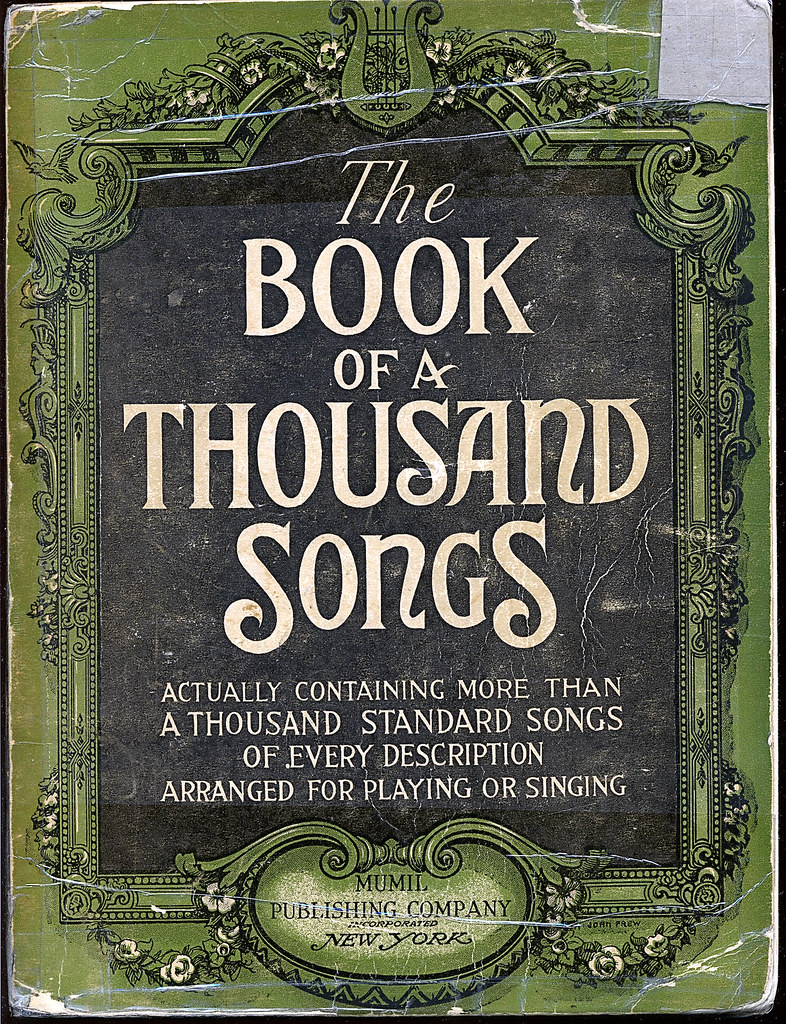
The Book of a Thousand Songs

The Book of a Thousand Songs. I first saw it on a shelf at Southern Music in San Antonio, TX, and a quick look convinced me I didn't need it. After returning home to Georgia, I suddenly decided I needed it after all, ordered it over the phone, and found that it's a trove of slightly shopworn treasures. The songs go from being as short as one line to taking a couple of pages, divided between ones that look like choral settings, ones that have a melody in one hand and the accompaniment in the other, and ones where the melody is woven into a rich enough piano part.

When we lived in Virginia, I found a second copy of this book. My first is a large volume, a little over half the thickness of a ream of paper and about the same size otherwise. The second copy was printed during wartime, so it's more petite and the paper is thinner. I rigged a cardboard slipcase for it and carried it in my backpack for years. I'm glad to have the lighter copy, as the somewhat improvised music stand on my electrical piano is not at its best with large, heavy volumes. When I get that messed-up hammer wire fixed on the other piano this won't be a problem.

The book is copyright 1918, edited by the once-ubiquitous Albert E(rnest) Wier, who is also responsible for Masterpieces of Piano Music, a glorious brick of sheet music covering everything from Bach to some formerly fashionable flashes in the pan who wrote painfully figurative little tone poems for the parlor player. It was part of the Music for the Millions series that brought so darn much culture to so many, and which have brought much joy to me personally. The older edition bore a MUMIL imprint, which first looked like a dignified Roman numeral. I eventually figured out its true meaning. (Can you figure it out, Dear Reader? The clue is in this paragraph!)

Sentimental songs! Operatic songs! Sacred songs! Hymns! Children's songs! Southern songs! College songs! Sea songs! Rounds! Patriotic songs! National and Folk songs! This book was put together back in the dim, forgotten days when it was actually possible for a song to come out of copyright (that's right, kids!), so it has snappy pop numbers from a couple of decades before 1918 and on back. It has classical tunes with sappy bromides fitted in place of the original dramatic intent (along with ones bearing apparent translations that are at least intended to be faithful) such as school children probably suffered to while developing a solid loathing for any and all forms of culture and uplift.

The book's most endearing feature is that it lets me make connections. I play this one, and realize where that tune comes from that I used to hear in the background of a cartoon, or where the lyric that Krazy Kat sings to himself is from. I play that one and it dawns on me that it was parodied in a Lewis Carroll book. I find more songs by Septimus Winner, a particular favorite, who wrote "Listen to the Mocking-Bird" and "Whispering Hope" under a pseudonym, as well as "Ten Little Indians" and "Der Deitscher's Dog" -- which we seem to know now as "Where Oh Where Has My Little Dog Gone," and which is as often as not generously credited to the prolific "Anonymous" in these lazy times.

I showed this to my musician father, and he now has a copy of his own. He also likes to do what I do, which is to play through it aimlessly, annotating when a light bulb goes off; writing in a missing composer or lyric source (Claribel! Dekker!) or other trivium ("It's possible that The Old Grey Goose is a parody of this"). I recently mentioned to Dad that I was playing through some pages in the book, and he asked how far I'd gotten. Oh no, I said, I meant I'd just started in the middle and had played a half dozen or so pages… but it got me thinking. Why not, I thought, start from the beginning (like I did once with Gems of the Universe) and play every song at least one time through, repeats optional?

So I did. Updates to follow. I'm up to about page 32 now. I don't intend to write about every song, just to hit the interesting spots. If the book interests you, it's still available, and probably not more than about 100% more than I paid for my first copy, which was ten bucks. There are also scans of it online, or there have been. If I come across it again, I'll post a URL. I have my own set of scans that I made for my own use, so even though I'm not carrying the book in my backpack these days (it's getting fragile, and I gave in and taped a couple of pages that wanted to be free), it still goes a lot of the same places I go.
.

Blog Archive